Put the two sites side by side and they look like the same product: a search box, a calendar, a list of hotels, a checkout. That resemblance is why most comparisons of Amex Travel and Expedia end up arguing about interface design, which is the least important thing about either of them.
The real difference is structural. Expedia is an open marketplace that anyone can use and that pays you a small, transparent rebate. Amex Travel is a closed benefit channel attached to a credit card. It pays a much larger reward, in a currency that is harder to value. Without the card it will not serve you at all. Which one is better is almost entirely decided by a question that has nothing to do with the trip: do you hold an American Express card, and if so, which one?
This post works through what each platform actually gives you, using both companies' own published terms and Expedia Group's latest annual report. Where we could not verify something directly, we say so.
Key takeaways
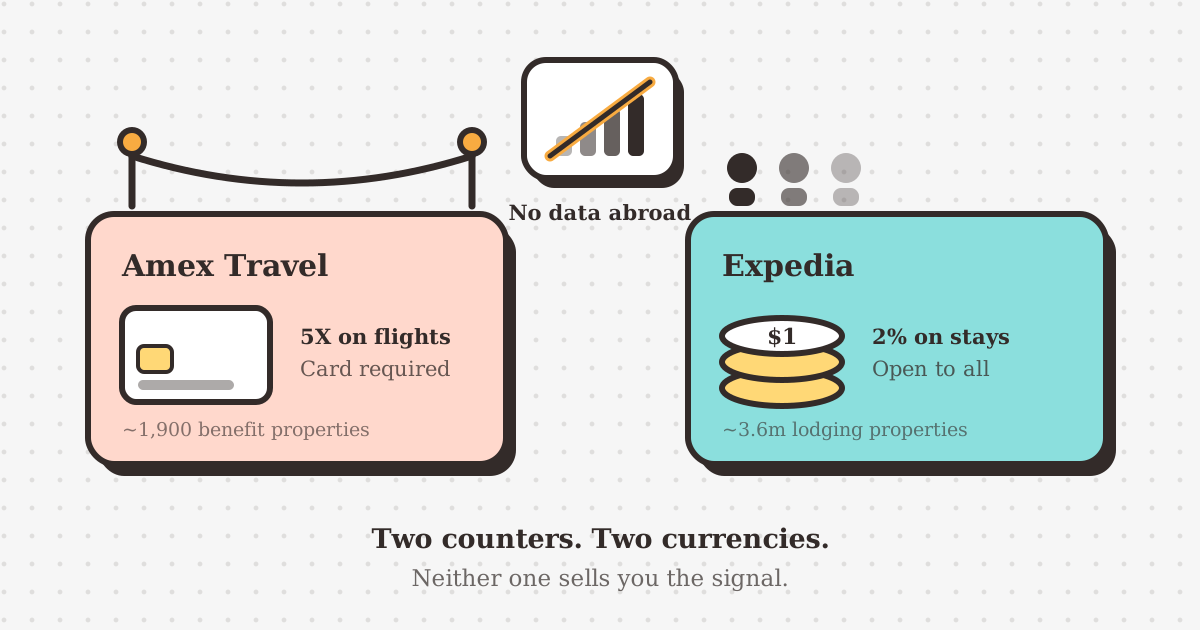
- The gap on flights is the headline. Amex Platinum earns 5X Membership Rewards on scheduled air tickets booked through Amex Travel; Expedia's One Key pays 0.2% OneKeyCash on flights at every tier. On a $1,200 fare that is 6,000 points against $2.40.
- Expedia wins on reach and access. Its 10-K puts the marketplace at roughly 3.6 million lodging properties, including about 2.4 million Vrbo listings. It costs nothing to join and takes any card.
- Amex Travel is gated. Bookings require an American Express Card in your own name, and Fine Hotels + Resorts is Platinum and Centurion only. The Platinum Card's annual fee is $895.
- Fine Hotels + Resorts has no Expedia equivalent: breakfast for two, a $100 property credit and guaranteed 4pm check-out at every participating property, with an average stated value of $550 per stay.
- OneKeyCash is easy to value and impossible to move: $1 each, usable only on Expedia, Hotels.com and Vrbo, not redeemable for cash.
- Amex runs a Lowest Hotel Rates Guarantee that refunds the difference on a cheaper public rate found online, though a long list of exclusions swallows most of the deals people actually find.
- Neither platform bundles mobile data abroad. Hotel Wi-Fi is not connectivity in transit, and no booking on either site gets you online between the aircraft door and check-in.
At a glance
| Amex Travel | Expedia | |
|---|---|---|
| Who can use it | Eligible American Express Card Members only, booking with a Card in their own name | Anyone; any payment method |
| Cost to access the best tier | The Platinum Card, $895 annual fee | Free; status earned by booking volume |
| Flight earn | 5X Membership Rewards (Platinum), up to $500,000 in charges per calendar year | 0.2% OneKeyCash, all tiers |
| Prepaid hotel earn | 5X Membership Rewards (Platinum) | 2% OneKeyCash base; 3–6% at VIP Access properties by status |
| Reward currency | Membership Rewards points, transferable to airline and hotel partners | OneKeyCash, $1 each, locked to Expedia, Hotels.com and Vrbo |
| Lodging inventory | Not published; benefit collections are ~1,900 (FHR) and 1,300+ (The Hotel Collection) properties | ~3.6 million lodging properties, incl. ~2.4 million Vrbo listings |
| Signature hotel perk | Fine Hotels + Resorts: fixed benefit stack, avg. stated value $550 per stay | VIP Access: bonus OneKeyCash and property-level perks |
| Price guarantee | Lowest Hotel Rates Guarantee, with exclusions | Published price guarantee on the consumer site |
| Pay at property | Limited; the best earn and credits require prepaid bookings | Yes, on participating hotels via Expedia Traveler Preference |
| Mobile data abroad | Not included | Not included |
The access question comes first
Everything else in this comparison is downstream of the fact that Amex Travel is a cardholder channel, and its terms gate each benefit individually rather than with one blanket sentence. The Lowest Hotel Rates Guarantee is "valid only for American Express Card Members." Pay with Points requires you to "charge your eligible purchase through American Express Travel to a Membership Rewards program-enrolled American Express Card." Platinum Member Airfares bookings "must be made by an Eligible Card Member using an American Express Card in their name." The pattern is the same everywhere: no guest checkout, no booking on a friend's behalf with their Visa, no using the portal to price-shop and paying elsewhere.
The gate goes higher for the parts people actually want. Fine Hotels + Resorts is available only to "U.S. Consumer, Business and Corporate Platinum Card Members, and Centurion Members." The Platinum Card carries an annual fee of $895, with additional Platinum Cards at $195 each.
Expedia has no gate at all. Join or don't; book with any card; earn either way. One Key status is earned by booking, not bought, though Expedia Group's own partner documentation is pointed about the catch: One Key members "must qualify annually — they're not automatically granted lifetime membership like some other travel rewards programs." Last year's Gold is not this year's Gold.
What you earn on flights: the 25x gap
This is the least ambiguous finding in the whole comparison, and the one most likely to change where you book.
American Express's terms for the Platinum Card give Basic Card Members 1 Membership Rewards point per dollar on eligible purchases and "4 additional points (for a total of 5 points) for each dollar charged for eligible travel purchases." Eligible travel purchases include "purchases of air tickets on scheduled flights, of up to $500,000 in charges per calendar year, booked directly with passenger airlines or through American Express Travel."
Expedia's One Key pays 0.2% in OneKeyCash on eligible flights, and that rate does not improve with status: Blue and Platinum members earn the same on an airfare.
On a $1,200 international ticket:
| Earn | |
|---|---|
| Amex Platinum via Amex Travel | 6,000 Membership Rewards points |
| Expedia One Key, any tier | $2.40 OneKeyCash |
Six thousand points is not six thousand dollars, and we are not going to pretend a Membership Rewards point has one fixed value. It does not, and anyone quoting you a single number is selling something. Transferred to an airline partner in the right redemption, those points can be worth several times what they fetch through the portal; spent carelessly, much less. But even at the most pessimistic sane valuation, 6,000 points clears $2.40 by a distance that no interface preference makes up.
Two Amex flight mechanics are worth knowing about, and both are narrower than they sound:
- Insider Fares are discounted-in-points fares that appear on AmexTravel.com only when you are logged in and hold enough points to cover the entire fare. Partial payment is not allowed. They exist on select flights only, so treat them as a windfall, not a plan.
- Platinum Member Airfares (formerly the International Airline Program) offer savings on "select economy tickets with limited participating airlines on designated international flights" and select domestic tickets. One booking can cover the Card Member and up to seven passengers on the same itinerary. Airline participation and availability change without notice.
If you hold a Membership Rewards card that isn't Platinum, the portal still pays: Amex's terms describe at least 1 point per dollar plus at least 1 additional point on eligible travel booked on AmexTravel.com or the Amex Travel App, a 2X floor. Still an order of magnitude above 0.2%.
What you earn on hotels: closer, and more conditional
Hotels are where Expedia fights back, partly because its rate is better and mostly because its inventory is enormous.
Amex Platinum's 5X covers "purchases of prepaid hotel reservations booked through American Express Travel" and prepaid vacation rentals booked through AmexTravel.com. Note prepaid: a pay-at-the-property booking does not earn the bonus, and a prepaid booking later modified directly with the hotel loses it.
One Key pays 2% OneKeyCash on eligible hotels, alternative accommodations, activities, packages, car rentals and cruises. At VIP Access properties, status multiplies it: roughly 3% at Silver, 4% at Gold and 6% at Platinum. Status comes from trip elements collected in a calendar year (about 5 for Silver, 15 for Gold and 30 for Platinum), and only elements worth $25 or more, excluding taxes and fees, count.
Run $1,400 of prepaid hotel spend through each:
| Earn | |
|---|---|
| Amex Platinum via Amex Travel | 7,000 Membership Rewards points |
| One Key, Blue tier | $28 OneKeyCash |
| One Key, Platinum tier at a VIP Access property | $84 OneKeyCash |
That last row is the one Expedia advocates point at, and fairly: $84 back is real money, immediately spendable, with no valuation argument attached. But it requires 30 qualifying trip elements in a calendar year and a VIP Access property, which is a narrow overlap for anyone who is not booking constantly through Expedia Group brands.
There is also a credit worth counting on the Amex side. The Platinum Card's $600 Hotel Credit returns up to $300 in statement credits semi-annually on prepaid Fine Hotels + Resorts and The Hotel Collection bookings made through Amex Travel. It is use-it-or-lose-it by half-year, and it only fires on those two collections, but two qualifying stays a year retire two thirds of the annual fee.
Inventory: Expedia is a different order of magnitude
Expedia Group's Form 10-K for 2025 is unusually specific about scale. As of 31 December 2025 the global lodging marketplace had "approximately 3.6 million total lodging properties available, including approximately 2.4 million online bookable alternative accommodations through Vrbo and approximately 1.2 million hotels and alternative accommodations through our other brands." Lodging accounted for 80% of worldwide revenue in 2025, and room nights booked grew 8%.
American Express does not publish a comparable figure for its general hotel search, and we are not going to invent one. Amex Travel's ordinary hotel inventory is broad, drawn from the same wholesale supply everyone in this business uses. What Amex publishes is the size of its benefit collections, which is a different thing:
- Fine Hotels + Resorts: over 1,900 properties, per the programme's own footnote.
- The Hotel Collection: 1,300+ upscale hotels, with a minimum stay of two consecutive nights.
So the honest comparison is not "3.6 million versus 3,200". It is: Expedia's advantage is breadth, especially in whole-home rentals where Vrbo alone is 2.4 million listings and Amex has no real answer; Amex's advantage is depth on a curated list, where the benefits are contractual rather than discretionary.
Book through Amex Travel when…
- You hold a Platinum or Centurion Card and are booking flights. The 5X earn is the single largest swing in this comparison
- You're booking a prepaid stay at a Fine Hotels + Resorts property and can use the $100 credit and the 4pm check-out
- You have $600 Hotel Credit left in the current half-year and a qualifying stay to spend it on
- You want points that can leave the platform. Membership Rewards transfer to airline and hotel partners; OneKeyCash cannot
- You're travelling with up to seven people on one itinerary and Platinum Member Airfares covers the route
Book through Expedia when…
- You don't hold an eligible American Express card, which settles it immediately
- You want a whole-home rental. Vrbo's 2.4 million listings have no Amex counterpart
- You want to pay at the property rather than prepay, which Expedia Traveler Preference supports on participating hotels
- You're booking activities, car hire or a cruise and want the same rewards currency across all of them
- You book through Expedia Group brands often enough to hold Gold or Platinum status and stay at VIP Access properties
Price guarantees: read the exclusions, not the headline
Both platforms advertise price protection. Amex's is the one we could read in full, and it is worth quoting because the exclusions do most of the work.
Under the Lowest Hotel Rates Guarantee, if you book a qualifying rate on amextravel.com or the Amex Travel App and then find "the same room, in the same hotel, for the same dates, the same number of children and adults, the same rate type and cancellation policy at a lower price online, before taxes and fees," Amex refunds the difference. For prepaid reservations the claim must be filed before check-in; for pay-later bookings, within 30 days after the stay.
Then the exclusions. The policy applies only to rates available to the general public. It excludes corporate, group, charter, convention, AAA, government, military and senior rates; rooms booked through or combined with "frequent stay, loyalty, points, coupon promotions"; rooms from contests or transfers; opaque sites that hide the hotel name until after booking; and promotional or all-inclusive packages.
That list rules out most of the cheaper prices a determined shopper actually turns up. The guarantee is real, and it is narrow. Treat it as insurance against a mispriced public rate, not as a promise that you will never overpay.
Redemption: easy to value, or easy to move
The two currencies fail in opposite directions.
OneKeyCash is the easiest reward currency in travel to understand: one OneKeyCash is worth $1 toward a booking on Expedia, Hotels.com or Vrbo. No award chart, no transfer ratios, no devaluation risk hiding in a partner's chart. The cost of that clarity is total lock-in: Expedia Group's own partner documentation states plainly that "OneKeyCash is not redeemable for cash and can only be used on Expedia, Hotels.com, and Vrbo." It also lapses if you go quiet: published trackers put the rule at inactivity of more than 18 months without an eligible booking or redemption.
Membership Rewards points are the reverse. They move, to airline and hotel transfer partners, which is where the outsized valuations in the points press come from. They can also be spent through the portal via Pay with Points, which has its own limits worth knowing: a minimum redemption of 5,000 points, and exclusions for non-prepaid car rentals and non-prepaid hotels. A point spent through the portal and the same point transferred to an airline can differ in value by a multiple, which is exactly why nobody can honestly tell you what your balance is worth without knowing your plans.
If you want a reward you can compute in your head, Expedia wins. If you want a reward with a ceiling, Amex does.
So which one is better?
For a traveller holding the Platinum Card: Amex Travel, for flights and prepaid Fine Hotels + Resorts stays; Expedia for almost everything else. The 5X flight earn and the Fine Hotels + Resorts benefit stack are hard to beat, and the $600 Hotel Credit is found money if you were staying somewhere nice anyway. But Amex has no answer to Vrbo, no equivalent breadth in activities and car hire, and its best rates require prepaying.
For a traveller holding a mid-tier Membership Rewards card: closer than you'd think. 2X on the Amex portal still beats 0.2% on flights by a mile, but on hotels, 2X against 2% OneKeyCash is roughly a wash that turns on how you value points.
For everyone else: Expedia, and it isn't close, because Amex Travel will not sell to you.
And for a lot of people the answer is both. Nothing stops you booking the flight through Amex Travel and the rental house through Vrbo. The platforms aren't exclusive; only the loyalty currencies are.
The gap neither one fills
Here is the thing that struck us reading both companies' terms end to end, and it is the reason we wrote this post rather than another points-blog table.
Between the aircraft door and the hotel check-in desk, neither platform has sold you anything.
Fine Hotels + Resorts includes complimentary Wi-Fi, in the room, at the property, after you have arrived. One Key earns and redeems on hotels, alternative accommodations, activities, packages, car rentals, flights and cruises, per Expedia Group's own description in its 10-K. Mobile data is not one of the categories, on either side. There is no eSIM in the cart, no roaming allowance attached to the booking, no data bundle in the $895 annual fee.
Which is fine, until you are standing in an arrivals hall. The confirmation number will not open. The rideshare app will not load. And your phone has just cheerfully connected to a roaming partner at whatever the day rate happens to be.
Filling that gap is a separate, small purchase, and it is worth making before you fly rather than after you land. eSIMs are the practical way to do it now. Any iPhone from the XS generation onward and most Android flagships of the last six years hold a travel profile alongside your home SIM. Your usual number keeps receiving calls and texts while data runs on the local network.
For reference, our own Europe plan covers 33 countries on one profile. It starts at $4.95 for 3GB over 30 days, with 10GB over 30 days at $8.95. The Asia-Pacific plan covers 12 countries from $4.95. Those are referral prices, which is what our links charge. Buy from us or don't. The point that matters is that neither booking platform will put this line item in front of you. It is the one that decides whether the rest of the itinerary works when you land.
Sort the data before you fly
Regional and country eSIMs from $4.95 USD. Live pricing, QR delivered through the website with an email when it's ready, no monthly commitment.
Browse plans by destinationWhat this comparison doesn't measure
- Customer support, for either company or for us. No controlled dataset exists, so any comparison would be anecdote.
- Nightly rate parity. We did not run a systematic price scrape across both platforms. Rates move hourly and both draw on overlapping wholesale supply; a single spot check would mislead more than it informed.
- Expedia's consumer-facing terms as fetched on the publish date. Expedia's sites block automated access from our network, so we sourced structural claims from the 10-K and Expedia Group's partner documentation, and earn rates from independent trackers. See the methodology note.
- Cancellation and change fees on either platform, which vary by fare, rate type and property rather than by platform.
- Travel insurance and card protections, which are card-product features rather than booking-platform features and deserve their own comparison.
- Non-US versions of either platform. Amex Travel's benefit terms differ by market, and One Key's rollout is still uneven outside the US and UK.
Frequently asked questions
Is Amex Travel cheaper than Expedia?+
Do I need an American Express card to book through Amex Travel?+
Which platform earns more on flights?+
What is OneKeyCash actually worth?+
Does Expedia have anything like Fine Hotels + Resorts?+
Do either Amex Travel or Expedia include mobile data abroad?+
Can I use both?+
Methodology
How we did this comparison
Every American Express figure in this post was read on 2026-09-19 from American Express's own published pages: the Fine Hotels + Resorts programme page, the American Express Travel programmes and benefits terms and conditions, and the Platinum Card product page. Where a benefit has a governing terms paragraph, we quote or paraphrase that paragraph rather than the marketing summary above it, because the two occasionally disagree. The same Amex Travel page describes Fine Hotels + Resorts as "1,800+ luxury properties" in its navigation and "over 1,900 extraordinary properties" in its body copy. We used the figure the programme's own footnote carries.
Expedia is harder to verify by machine, and we want to be straight about how we handled it. Expedia Group's consumer sites (expedia.com, hotels.com, vrbo.com) return HTTP 429 to every automated request from our network, including the One Key terms page at expedia.com/one-key-terms, which is the governing document for everything One Key does. We could not fetch it on the publish date, so we did not cite it as though we had. Instead, the structural claims in this post (what One Key is, which brands and categories it spans, when it launched in each market, how large Expedia Group's lodging marketplace is) come from Expedia Group's Form 10-K for the year ended 31 December 2025, filed with the SEC on 13 February 2026, and from Expedia Group's own partner-facing One Key page. The earn-rate percentages and status thresholds, which the 10-K does not enumerate, are carried by at least two independently published trackers that agree with each other. Check your own account's terms before planning around a number: Expedia has changed One Key earn rates since launch, and the terms page is what binds.
We did not compare customer support for either company, in any form. We have no controlled, apples-to-apples dataset on resolution times for American Express, for Expedia Group, or for ourselves, so any such comparison would be an anecdote in a lab coat.
We are Lotsotravel and we sell travel eSIMs, which is a product neither of these companies sells. That is a smaller conflict of interest than our competitor comparisons carry, but it is not zero: the last section of this post argues that both platforms leave a gap we happen to fill. Read it knowing that, and note that we do not earn a commission from either company. There are no affiliate links in this post.
Lotsotravel prices are our live v3 Fixed Data catalogue, read from our own products API on 2026-09-21. They are the referral prices our links carry, which is what you pay arriving through a link in this post; a visitor landing with no referral sees a list price about a dollar higher per plan.
Sources & references
We verify carrier and regulator pricing directly from primary sources before publishing. Pricing is current as of the article's last update — always confirm rates on the carrier's site before you travel.
- Fine Hotels + Resorts: bookings, benefits and programme terms — American Express
- American Express Travel programmes and benefits terms and conditions — American Express
- The Hotel Collection — American Express
- The Platinum Card: annual fee and benefits — American Express
- Insider Fares — American Express
- Platinum Member Airfares — American Express
- How to use your $600 Hotel Credit — American Express
- Expedia Group, Inc. Form 10-K for the year ended 31 December 2025 — U.S. Securities and Exchange Commission
- One Key Rewards Program (partner documentation) — Expedia Group
- Expedia Group corporate site — Expedia Group
- Expedia One Key Rewards: earn rates, status thresholds and expiry — AwardWallet
- Expedia's One Key Rewards Program: how it works — Upgraded Points
- Expedia launches One Key loyalty program — CNBC Select
- Lotsotravel: destinations and live pricing — Lotsotravel
- Set up an eSIM on iPhone — Apple
- About eSIM — GSMA
About the author
Lotsotravel Team
The Lotsotravel editorial team writes hands-on guides for international travelers. We test eSIMs on real devices in real destinations, monitor Canadian and U.S. carrier pricing weekly, and compare coverage across local network partners before we recommend a plan. Every comparison post is updated when carriers change their rates so the numbers you read here match what you would pay today.
Last updated: September 23, 2026